

Proposition 65
Safe Drinking Water and Toxic Enforcement Act of 1986
California Proposition 65 requires businesses to provide clear and reasonable warnings before exposing consumers to chemicals known to cause cancer, birth defects, or other reproductive harm. With over 900 listed chemicals and aggressive private enforcement through bounty-hunter lawsuits, Prop 65 is one of the most consequential product compliance regulations for any company selling consumer goods in the United States.
What you receive
Prop 65 Assessments & Warning Determinations
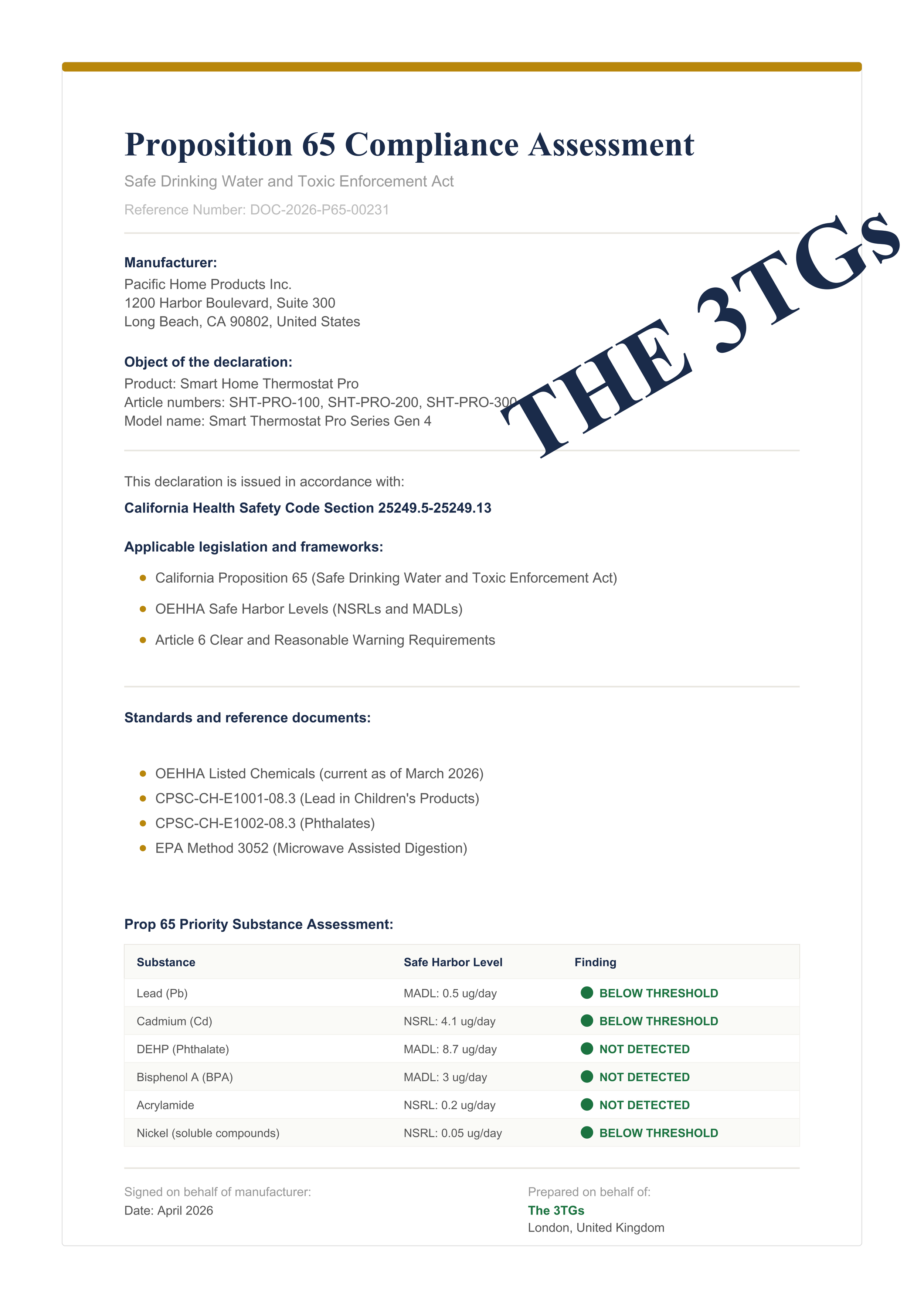
We deliver defensible Prop 65 compliance assessments that document your warning determination, quantify exposure levels against safe harbor thresholds, and provide the evidence trail you need if a 60-day notice arrives.
- Chemical risk assessment against the full Prop 65 listed substances
- Warning determination with safe harbor language when required
- Supplier substance inquiry data to quantify exposure levels
- Documentation to support no-warning determinations where applicable
Any business with 10 or more employees that sells products in California or that could end up in the hands of California consumers. This includes manufacturers, importers, distributors, and retailers. Because California is the world's fifth-largest economy, most companies selling in the U.S. are effectively subject to Prop 65.
- Provide clear and reasonable warnings for products that expose consumers to listed chemicals above safe harbor levels
- Warnings must comply with specific format, content, and placement requirements updated in 2018
- No pre-market testing or certification is required, but the burden of proof falls on the business if challenged
- Private enforcers (bounty hunters) can file 60-day notice letters and lawsuits seeking penalties and legal fees
- Settlements and judgments are public record and can damage brand reputation
Enforcement reality
- Over 900 chemicals on the Prop 65 list across cancer and reproductive toxicity categories
- Safe harbor levels (NSRLs and MADLs) exist for some but not all listed chemicals
- Private enforcement generates thousands of 60-day notices per year
- Average settlement costs range from $30,000 to $200,000+ per case
- Common targets: lead in consumer products, cadmium in jewelry, phthalates in plastics, acrylamide in food
- Assuming Prop 65 only applies to products sold directly in California retail stores
- Not testing products for substances that are commonly present in similar product categories
- Using generic warning language that does not meet current safe harbor requirements
- Relying on supplier assurances without independent verification
- Ignoring Prop 65 updates (new chemicals are added regularly)
- Not maintaining documentation to support a no-warning determination
- Product-level chemical risk assessment against the full Prop 65 list
- Warning determination: whether a warning is required and which chemicals trigger it
- Safe harbor warning language review and formatting guidance
- Supplier substance inquiry campaigns to quantify chemical exposure levels
- Lab testing coordination for high-risk products and materials
- Ongoing list update monitoring and impact analysis
- Documentation to support no-warning determinations where applicable
Need Prop 65 compliance support? We assess your products, determine your warning obligations, and build the documentation to defend your position.
Contact Us →info@3tgs.org · +44 20 3996 3623