

EU WFD / SCIP
Waste Framework Directive & ECHA SCIP Database
The EU Waste Framework Directive requires companies to notify ECHA's SCIP database when placing articles on the EU market that contain substances of very high concern (SVHCs) above 0.1% w/w. SCIP (Substances of Concern In articles as such or in complex objects/Products) creates a publicly accessible database to support waste treatment and circular economy goals. For product companies, this means an additional data submission obligation on top of existing REACH requirements.
What you receive
SCIP Notifications & Article-Level Assessments
We deliver complete SCIP dossiers ready for submission to ECHA, including article-level SVHC assessments, hierarchical complex object structures, and the supplier data needed to support each notification.
- Article-level SVHC assessment for every component in your complex objects
- Hierarchical SCIP dossier preparation in IUCLID format
- Supplier data collection for substance presence determination
- Integration with your existing REACH compliance program
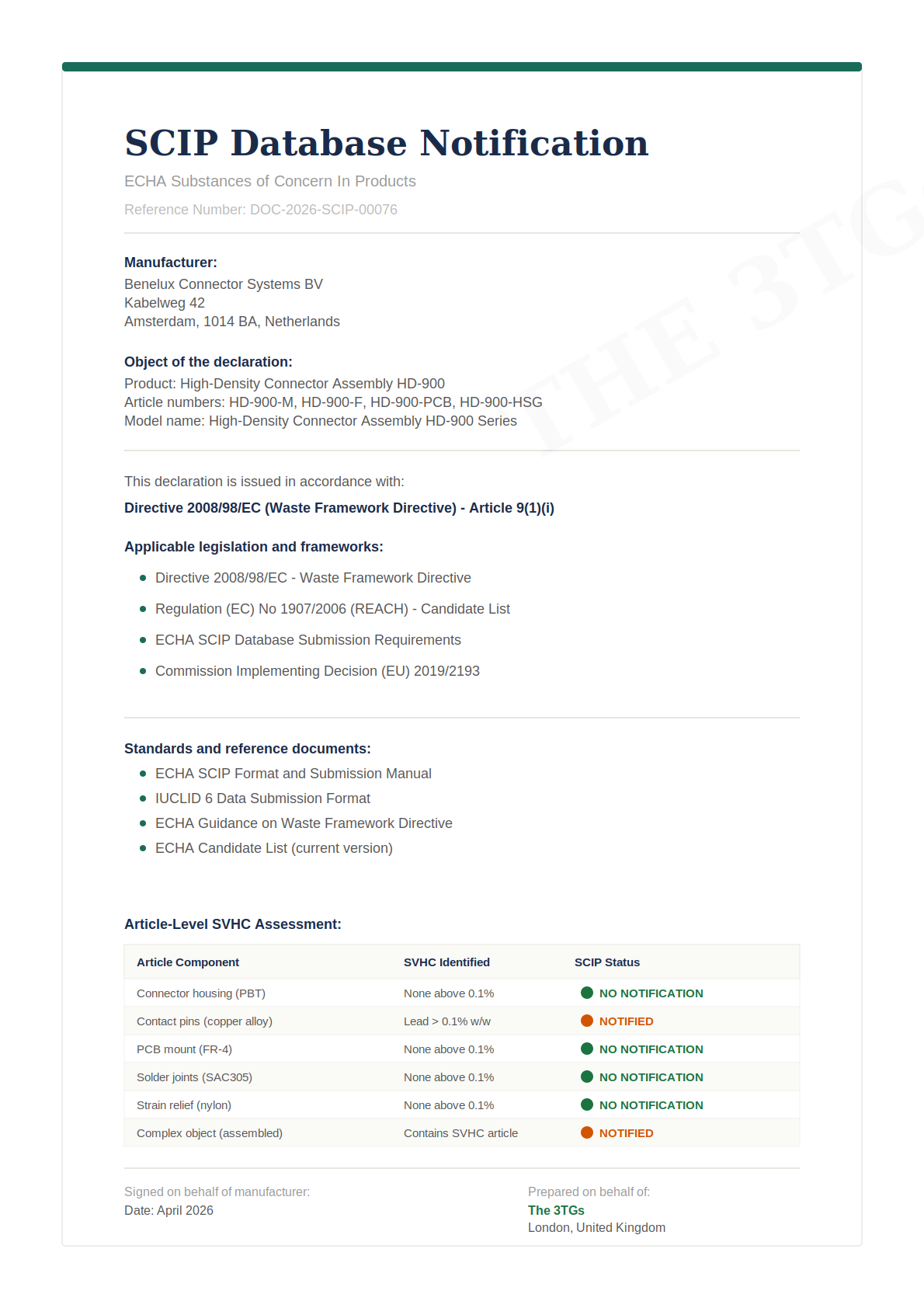
Any EU-based manufacturer, importer, or assembler that places articles containing SVHCs above 0.1% w/w on the EU market. Unlike REACH Article 33 (which requires communication to customers), SCIP requires direct notification to ECHA. This applies whether you are the original manufacturer or a company assembling complex articles from components sourced from others.
- Notify ECHA via the SCIP database for every article or complex object containing SVHCs above 0.1% w/w placed on the EU market
- SCIP dossiers must include article identification, SVHC name and concentration, safe use information, and article category
- Complex objects require hierarchical dossier structures reflecting the article-within-article composition
- SCIP submissions use ECHA's IUCLID format and submission portal
- Obligations are ongoing: new products, new SVHCs on the Candidate List, and product changes can all trigger new or updated submissions
Key thresholds
- 0.1% w/w (weight by weight) per article, not per product, triggers SCIP notification
- Assessment must be done at the article level, meaning individual components within a complex product must each be evaluated
- The obligation applies from the date an SVHC is added to the Candidate List
- SCIP data is publicly accessible and used by waste operators and recyclers
- Confusing SCIP obligations with REACH Article 33 communication requirements
- Not understanding the article-within-article assessment approach required for complex products
- Relying on product-level assessments when article-level analysis is required
- Not updating SCIP dossiers when new SVHCs are added to the Candidate List
- Lacking the supplier data needed to determine SVHC presence at the article level
- Treating SCIP as optional or low priority because enforcement has been inconsistent
- SCIP applicability assessment based on product composition and available substance data
- Article-level and BOM-level SVHC analysis for complex products
- Supplier data collection campaigns to obtain the substance data needed for SCIP submissions
- SCIP dossier preparation including hierarchical structures for complex objects
- Submission support through ECHA's IUCLID portal
- Integration of SCIP workflows with existing REACH compliance programs
- Ongoing monitoring for Candidate List updates that trigger new SCIP obligations
Need SCIP compliance support? We handle the data collection, dossier preparation, and submission so your articles meet their notification obligations.
Contact Us →info@3tgs.org · +44 20 3996 3623