

POPs
Persistent Organic Pollutants
Persistent Organic Pollutants (POPs) are chemicals that persist in the environment, bioaccumulate through the food chain, and pose risks to human health. Regulated under the Stockholm Convention (globally) and the EU POPs Regulation (EU 2019/1021), these substances are either banned or restricted to very low concentration limits in products. The list of regulated POPs continues to grow, and enforcement is tightening.
What you receive
POPs Declarations & Substance Screening Reports
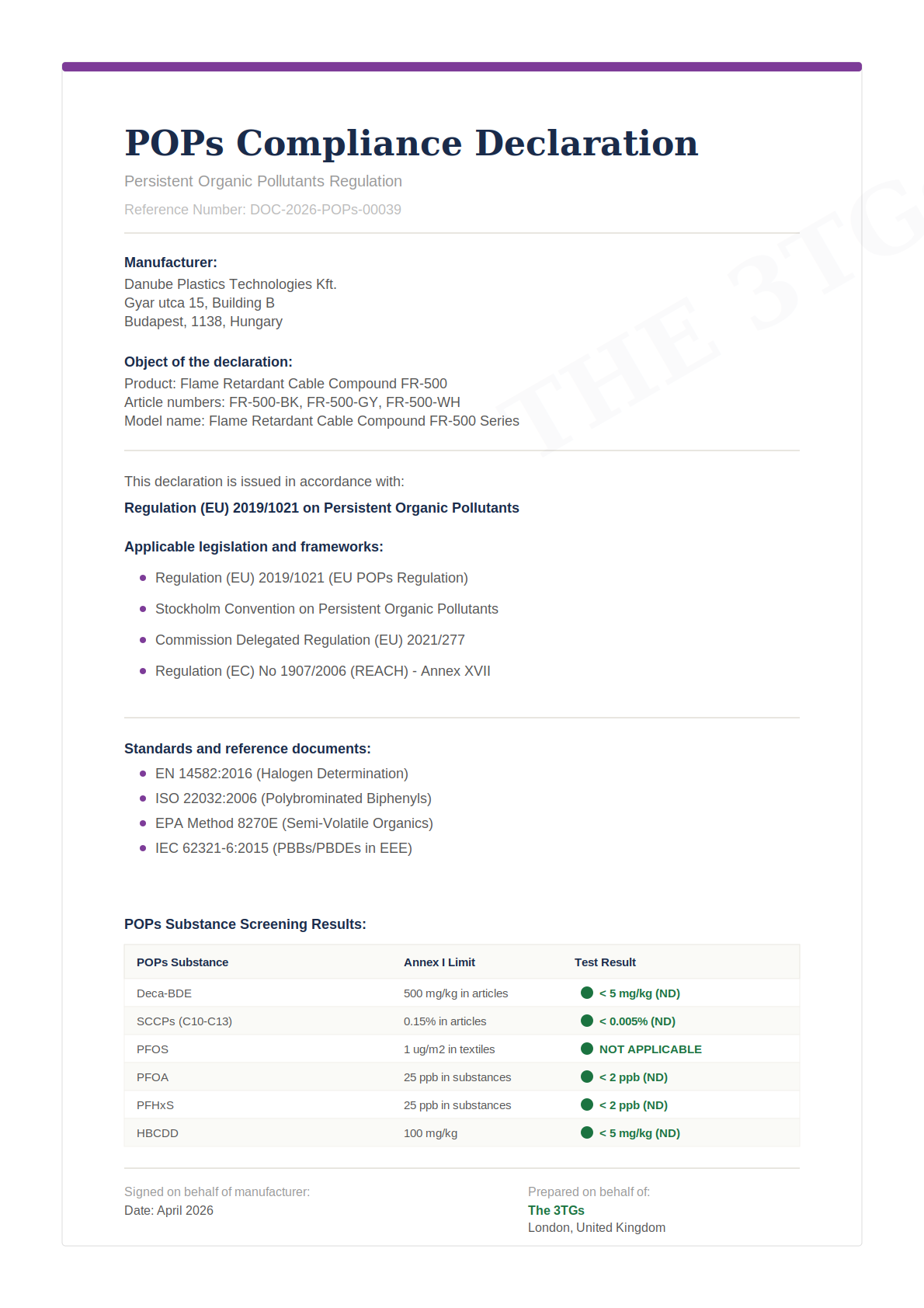
We deliver POPs compliance documentation including substance screening against current Annex I concentration limits, analytical verification results, and the regulatory tracking needed to stay ahead of new POPs listings.
- Screening against all regulated POPs including Deca-BDE, SCCPs, PFOS, and PFOA
- Concentration verification against Annex I threshold limits
- Lab testing coordination for analytical confirmation
- Regulatory tracking for new POPs listings and threshold changes
Manufacturers, importers, and distributors placing products on the EU market or in jurisdictions that implement the Stockholm Convention. POPs restrictions apply broadly across product categories. If your products contain flame retardants, plasticizers, surface treatments, or legacy chemicals, POPs compliance is relevant.
- Annex I substances are prohibited: products containing these POPs above specified concentration limits cannot be placed on the market
- Annex II substances are restricted with specific conditions of use
- Unintentional trace contaminant limits apply: even residual presence above the threshold triggers non-compliance
- Waste containing POPs above specified limits must be destroyed or irreversibly transformed
- Member state enforcement agencies conduct market surveillance and can withdraw non-compliant products
Key substances and limits
- PFOS: 10 mg/kg (0.001%) in substances; 1 ug/m2 in textiles and coated materials
- PFOA and its salts: 25 ppb; PFOA-related compounds: 1000 ppb
- Deca-BDE: 10 mg/kg (0.001%) in substances and mixtures; 500 mg/kg in articles
- SCCPs (Short-Chain Chlorinated Paraffins): 0.15% in substances, mixtures; 0.15% in articles
- PFHxS: recently added under the Stockholm Convention
- The list is regularly updated as new POPs are identified and added
- Not screening for legacy POPs that may still be present in older formulations or recycled materials
- Confusing POPs limits with REACH SVHC thresholds (they are different regulations with different limits)
- Missing newly added POPs because the compliance program was set up against an older version of the list
- Not testing for unintentional trace contamination, which can exceed thresholds even in products not intentionally containing POPs
- Relying on supplier assurances without analytical verification for high-risk materials
- Not maintaining documentation sufficient to demonstrate compliance during market surveillance
- POPs screening across product materials, components, and formulations
- Concentration limit verification against current Annex I and Annex II thresholds
- Supplier data collection and declaration campaigns for POPs-relevant substances
- Lab testing coordination for analytical verification of POPs presence
- Regulatory tracking for new POPs listings and threshold changes
- Compliance documentation and audit readiness for market surveillance
- Integration with REACH and RoHS compliance programs to avoid duplication
Need POPs compliance support? We screen your products, verify concentrations, and maintain your documentation against a list that keeps growing.
Contact Us →info@3tgs.org · +44 20 3996 3623